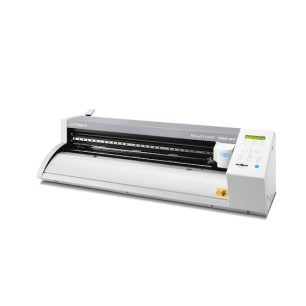
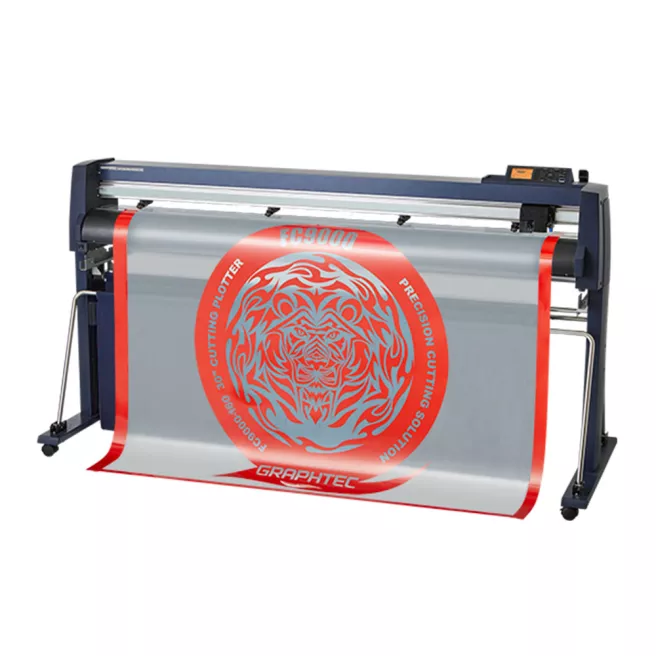
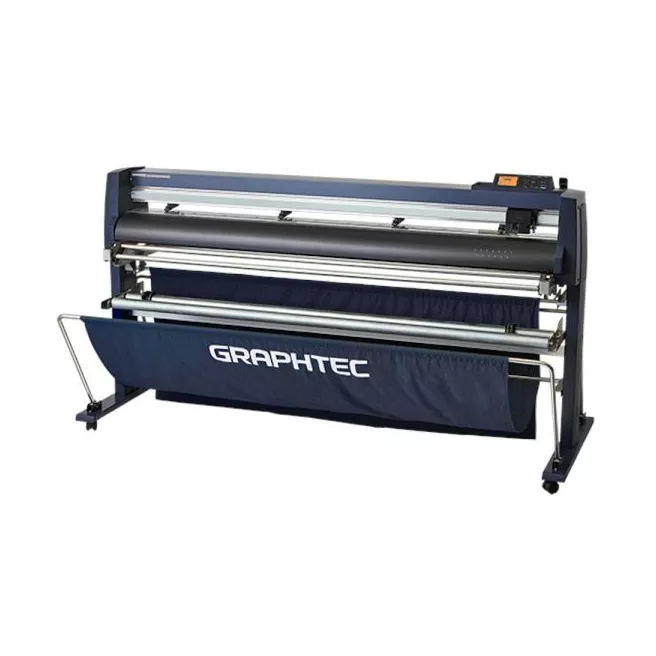
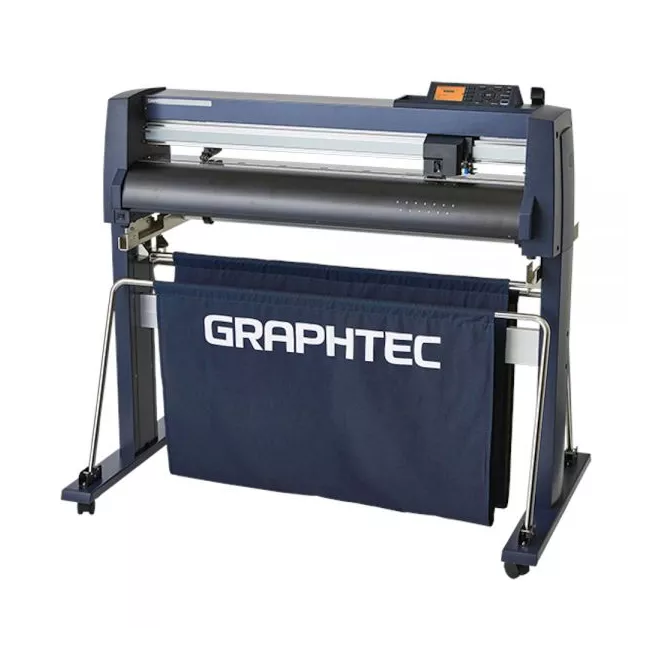
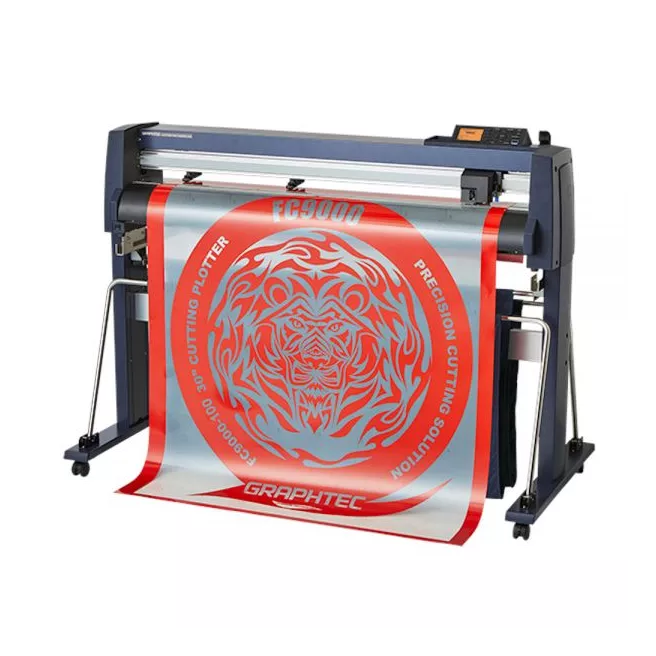
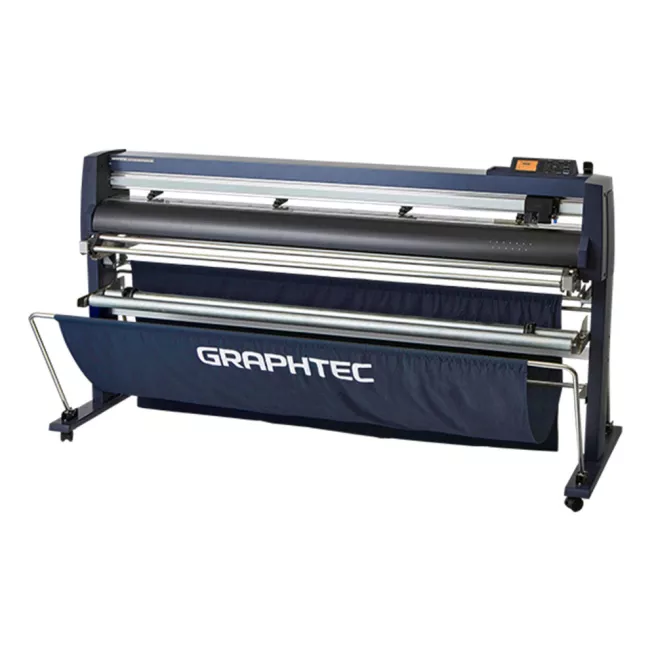
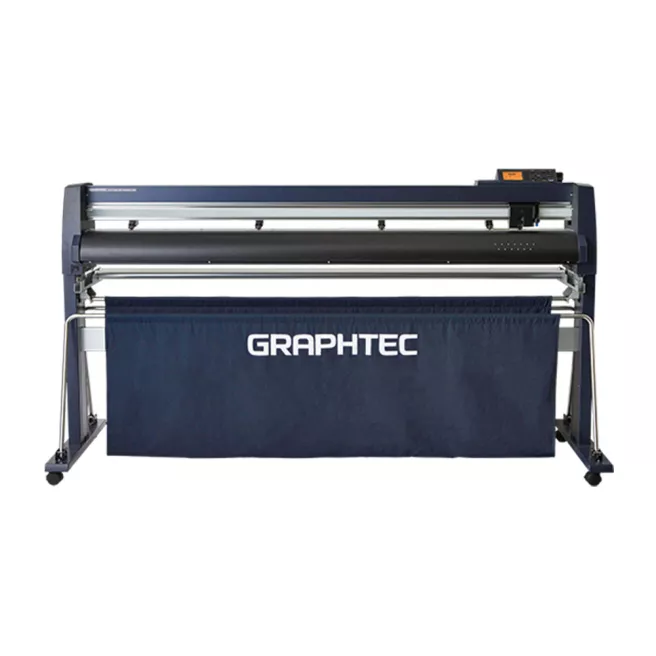
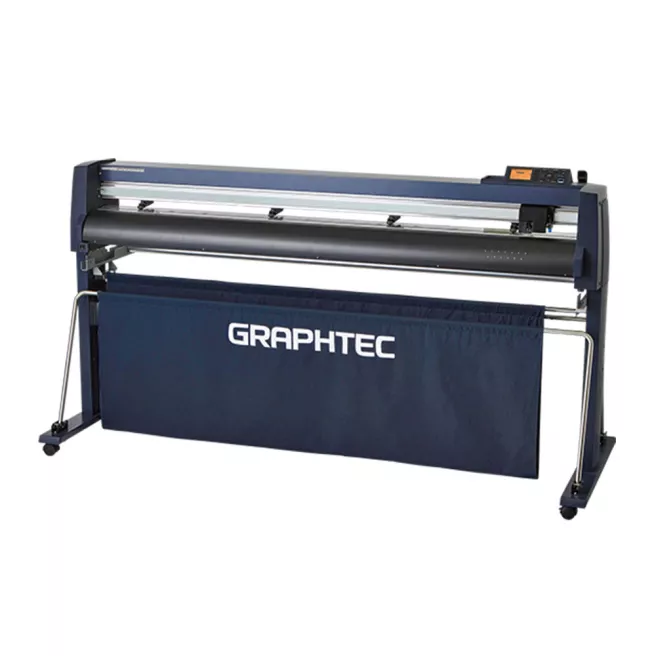
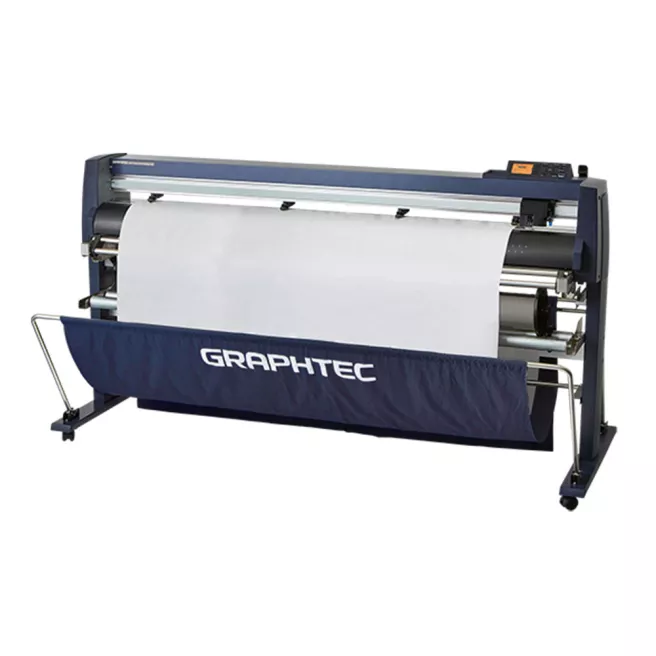
Graphtec FC9000 High-end cutting plotter – widths from 75 cm to 160 cm – XY deformation compensation


- Free shipping from 300 €*
- Quick shipping in the whole world
- Certified technical service Quick support
- Custom advices & quotes Secured payment
FC9000
Print & Cut rarely fails on the cutting. It fails on the registration.
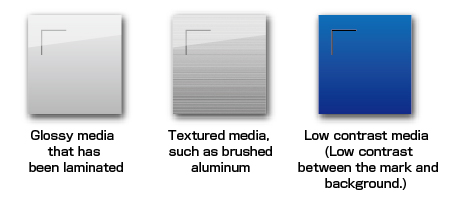
A holographic film bouncing light back, a high-intensity reflective, a mark printed on a coloured background: conventional sensors lose track, and the whole sheet is scrap.
The FC9000’s ARMS 8.0 sensor was redesigned for exactly those media. It reads them, aligns, cuts.
Three other things it does:
✓ Cut outside the registration mark area — you reclaim the margin wasted around every sheet.
✓ Chain different jobs on one roll, by barcode reading.
✓ Run from your own RIP — integrated with Roland VersaWorks 7 and Mutoh VerteLith, for a continuous print-and-cut workflow.
Combinations available
Check some of theses attributes to see what attribute combination is available

|
Ref: FC9000-75 |
Available now |

|
Ref: FC9000-100 |
Available now |

|
Ref: FC9000-140 |
Available now |
|
|
Ref: FC9000-140-OPH-A43 |
Available now |

|
Ref: FC9000-160 |
Available now |
|
|
Ref: FC9000-160-OPH-A44 |
Available now |
More info
● ● ● Professional cutting plotter · Graphtec
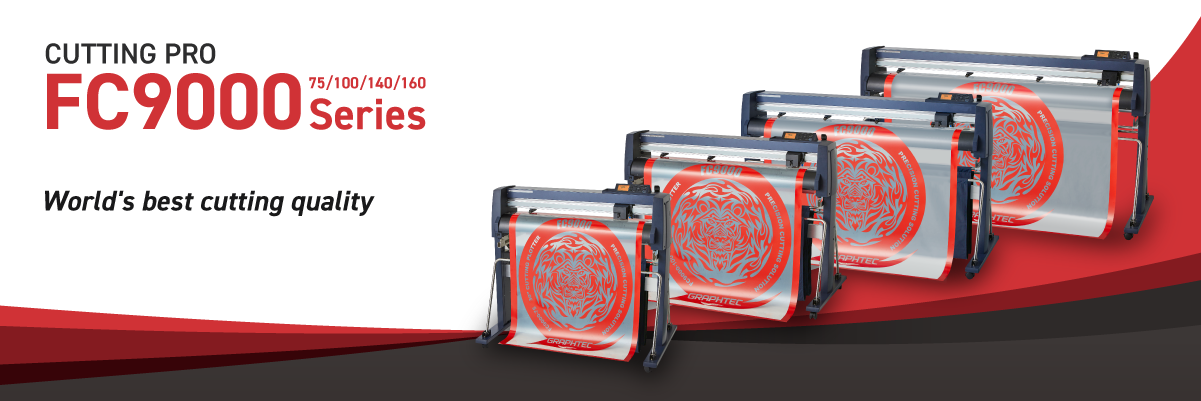
Graphtec CUTTING PRO FC9000
The cutting plotter that stops missing registration marks.
Professional cutting plotter in four widths, from 762 to 1626 mm. 1485 mm/s, 600 g of force and 0.1 mm repeatability. ARMS 8.0 registration sensing that reads holographic and reflective media, cutting beyond the mark area to save material, continuous barcode-driven production. Integrated with Roland VersaWorks 7 and Mutoh VerteLith for a continuous print-and-cut workflow.
1485 mm/s
Cutting speed
600 g
Cutting force · 5.88 N
0.1 mm
Repeatability over 2 m
1626 mm
Max width · 4 models
15 m
Long-length cutting
ARMS 8.0
Automatic registration sensing
● ● ● In short
Print & Cut rarely fails on the cutting. It fails on the registration.
A holographic film bouncing light back, a high-intensity reflective, a mark printed on a coloured background: conventional sensors lose track, and the whole sheet is scrap. The FC9000's ARMS 8.0 sensor was redesigned for exactly those media. It reads them, aligns, cuts.
ARMS 8.0 reads difficult media
Holographic, high-intensity reflective, colour-printed marks: the sensor algorithm was reworked for them.
Cutting beyond the mark area
Expanded Cutting Area reclaims the margin wasted around every sheet. Less waste, less material bought.
Barcode-driven production
A roll holding ten different jobs is cut in one run, each file retrieved by reading its barcode.
Driven from your RIP
Integrated with Roland VersaWorks 7 and Mutoh VerteLith: printing and cutting are prepared and launched from the same software, with no file handover.
● ● ● Production workflow
A continuous print-and-cut workflow
The FC9000 is not an isolated station at the end of the line. It is driven from your printer's RIP: the same software that prepares and launches the print sends the cutting job to the plotter. No re-export, no second application, no file handover between two workstations.
Roland DG printer
VersaWorks 7
The Roland DG RIP drives Graphtec plotters directly. Jobs prepared once, printing then cutting chained from the same interface.
Mutoh printer
VerteLith
Same principle with the Mutoh RIP: the FC9000 fits into the VerteLith workflow for an unbroken print-then-cut sequence.
Everything else
Barcode management
Epson, Ricoh or any other fleet: barcode reading retrieves the cutting file independently of the printer and the RIP.
What it changes: your printer never stops producing
On an integrated print-and-cut machine, both operations share the same machine time: while the head is cutting, it is not printing. Splitting them across a printer and an FC9000 lets both stations work in parallel. The printed roll moves to the plotter while the next one prints.
| Integrated print & cut machine | Printer + FC9000 | |
|---|---|---|
| Machine time | Printing and cutting in series | In parallel |
| Throughput | The sum of both operations | The slower of the two stations |
| If one station fails | All production stops | The other station keeps running |
| To add capacity | Replace the machine | Replace one station only |
The choice is about volume, not principle: below a certain throughput an integrated machine stays simpler and takes less floor space. As soon as cutting becomes the workshop bottleneck, decoupling the two stations immediately frees up printing time. We work that calculation out with you.
● ● ● The differentiator
ARMS 8.0: the feature that justifies the purchase
On a cutting plotter, speed impresses in a demo. Registration is what decides profitability in production. Three concrete improvements in this version.
It reads the media that caught out earlier generations
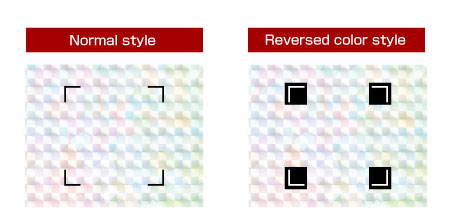
The sensor algorithm was reworked for holographic and reflective films and for colour-printed marks. Those are precisely the high-value media — safety signage, premium wraps, special stickers — so exactly where scrap costs most.
It takes Illustrator crop marks as they are
Through Cutting Master 5, Adobe Illustrator's native crop marks are recognised directly, both Japanese and Roman types. One file-preparation step disappears, and with it a source of error.
It corrects drift in both X and Y directions
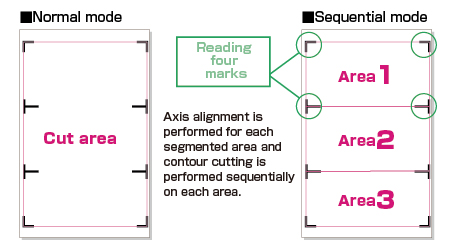
Segmented compensation now works on X and Y, whenever the gap between marks exceeds 600 mm. On a large graphic, each segment is realigned independently instead of receiving one approximate global correction.
Three features that show up in your operating result
Expanded Cutting Area — the material you used to throw away
The machine cuts beyond the area bounded by the marks. In practice: on a sticker sheet you run the cuts right to the usable edge of the media instead of leaving a dead margin all around. On printed vinyl, at several centimetres per sheet and several sheets a day, the waste avoided adds up to rolls over a year.
Data Link — the roll that cuts itself
A dedicated BARCODE key on the machine. You print a roll holding ten different jobs, each with its barcode. The FC9000 reads, retrieves the file — on PC or USB stick — cuts, feeds on, reads the next. Start Mark detection chains the files in sequence, with winding in both directions.
And above all: this works independently of the printer and RIP in use. A Roland DG today, an Epson or a Mutoh tomorrow: the plotter stays.
Auto panelling — accuracy over long lengths
The machine automatically splits long jobs into successive pages, reducing the feed length on each pass. Drift is contained, and the guaranteed length can be exceeded with better accuracy than a single feed.
● ● ● Performance
What each figure buys you
A digital servo motor and grit-roller drive, on a chassis sized for those accelerations.
| The figure | What it buys |
|---|---|
| 1,485 mm/s | Holding the pace on sticker and lettering runs. |
| 39.2 m/s² | The real gain on complex designs made of thousands of short moves — it is acceleration, not top speed, that sets the actual cycle time. |
| 5.88 N — 600 g | Tackling high-intensity reflective and thick films that entry-level plotters refuse. |
| 0.1 mm over 2 m | Cuts superimpose from one piece to the next: a run stays a run. |
Cutting without a PC, and producing overnight
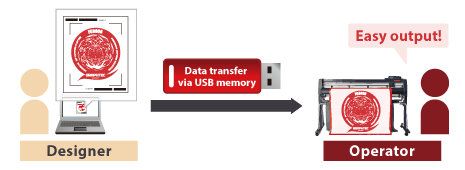
USB output. A file prepared in Cutting Master 5 or Graphtec Studio 2 and saved to a stick is cut by simply plugging the stick into the machine. The design workstation is freed up, the plotter runs alone.
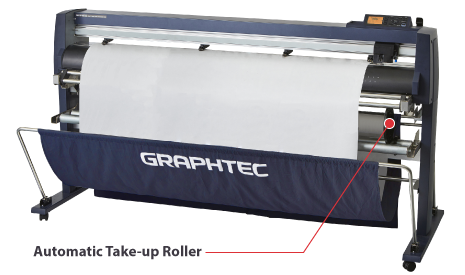
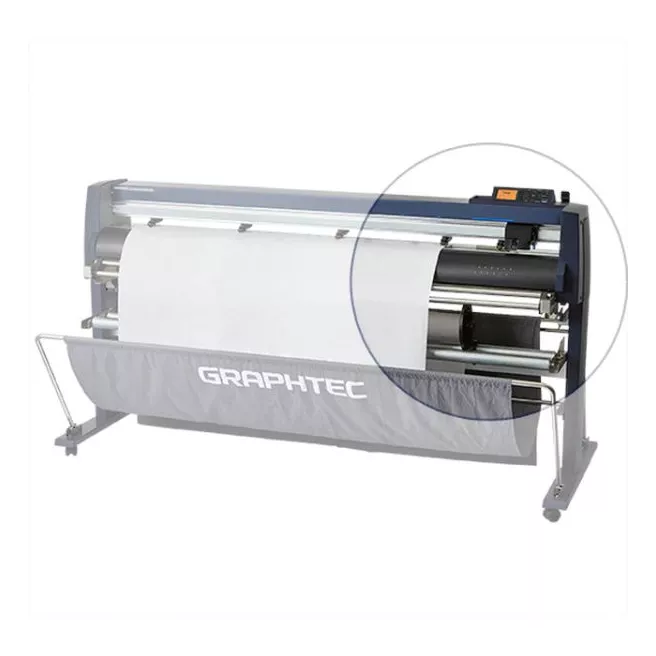
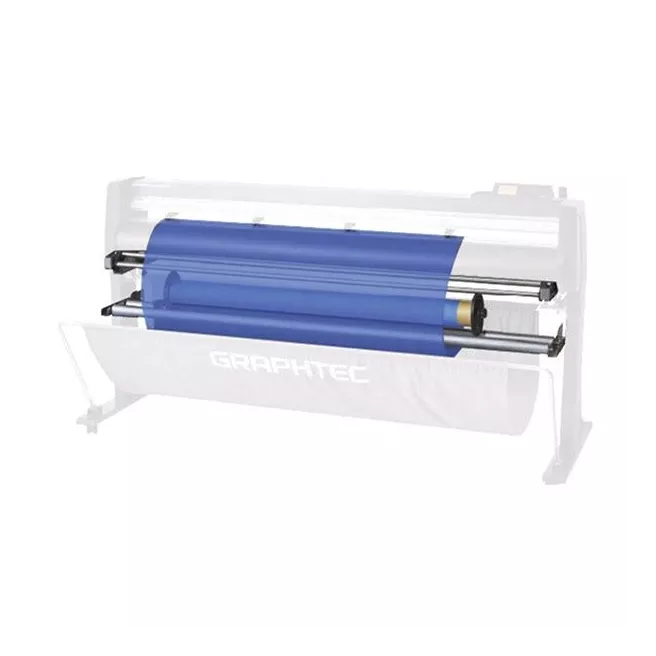
The automatic take-up (optional on the 140 and 160 models) winds the media as it cuts: guaranteed accuracy over 20 m for jobs under 1.2 m, maximum winding diameter 180 mm. That is what makes unattended overnight production genuinely reliable.
● ● ● Four models
Which width to choose
The rule is simple: match the width to the widest roll you print, with edge margin to spare.
| Model | Cutting | Max media | Who for |
|---|---|---|---|
| FC9000-75 | 762 mm | 920 mm | Textile and heat-transfer workshops, small formats |
| FC9000-100 | 1,067 mm | 1,224 mm | Window graphics, POS |
| FC9000-140 | 1,372 mm | 1,529 mm | The signage standard |
| FC9000-160 | 1,626 mm | 1,850 mm | 1.5 m production and vehicle wrapping |
✓ The 140 and 160 models accept the optional automatic take-up (OPH-A43 / OPH-A44) and a 5th push roller. Minimum media width: 50 mm across the range. Rolls up to 24 kg depending on the model.
● ● ● Applications
What you produce with it
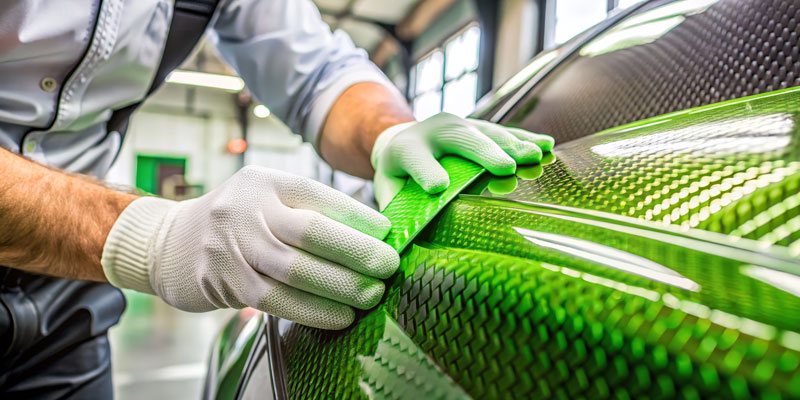
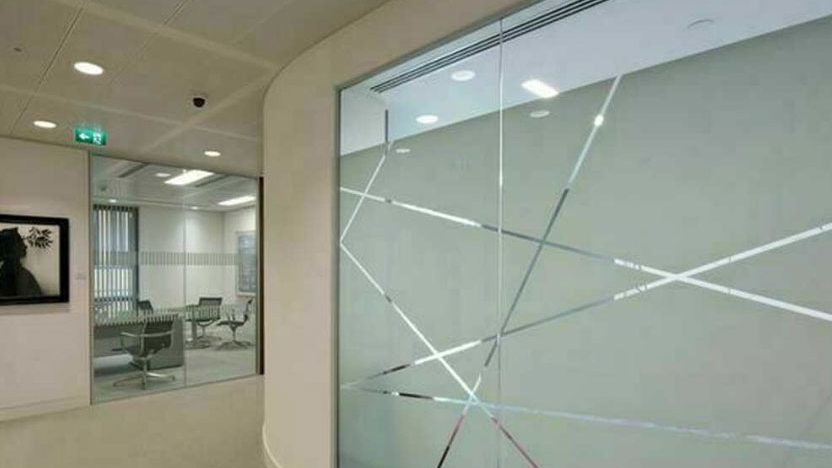
Vehicle wrapping and lettering
Vehicle graphics, window lettering, façade decals.
Stickers and reflective signage
Sticker sheets, decals, reflective films and road-safety signage.
Supported media — thickness ≤ 0.25 mm: marking film (PVC, fluorescent, reflective), polyester film under conditions, high-intensity reflective film (Diamond grade, Engineer grade), paper and card with CB15U blades.
● ● ● Technical data
Essential specifications
| Cutting | |
| Type | Grit-rolling plotter, digital servo motor |
| Cutting speed | 1,485 mm/s at 45° |
| Acceleration | 39.2 m/s² |
| Cutting force | 5.88 N (600 gf) |
| Repeatability | 0.1 mm over a path up to 2 m |
| Mechanical resolution | 0.005 mm |
| Minimum character size | approx. 5 mm |
| Media and lengths | |
| Cutting width | 762 to 1,626 mm depending on the model |
| Minimum media width | 50 mm |
| Media thickness | ≤ 0.25 mm |
| Cutting length | up to 15 m — 20 m with take-up |
| Equipment | |
| Mountable tools | 1 tool holder, 2 optional (ECK0013) |
| Display | Backlit graphic LCD 3.7", 10 languages |
| Connection | USB 2.0 · Ethernet |
| Power supply | 100 to 240 V, 120 W max |
| Footprint | 1,360 to 2,224 mm wide · 49 to 70 kg · stand and basket included |
The software is included
Two applications included, downloadable from the Graphtec website. An internet connection is required at first launch for activation.
✓ Cutting Master 5
Adobe Illustrator and CorelDRAW plug-in. Cutting conditions synchronised with the plotter, registration mark placement, tiling, matrix copy, weeding line, cutting conditions by layer and by colour, barcode management, offline output via USB stick.
✓ Graphtec Studio 2
Standalone creation and output software. Same features, plus object merging and tracing. Usable with no third-party software. Imports AI, CDR, PDF, DXF.
Windows 11 and macOS up to 26 Tahoe, 64-bit. Adobe Illustrator up to the 2026 versions, CorelDRAW up to 2025 — Windows only for CorelDRAW.
✓ Both applications remain useful for preparation work, but they are not essential day to day if you drive the plotter from VersaWorks 7 or VerteLith.
● ● ● Our support
What Digital-sys adds
01Choosing the width
We match it to your actual printer fleet, not to a catalogue. Too narrow and you have to panel; too wide and you pay floor space for nothing.
02Choosing the blades
This is where day-to-day cut quality is decided, and it is what nobody explains at purchase. High-intensity reflective, vehicle film and card use neither the same angle nor the same diameter. We start from your media.
03Installation and training
On Cutting Master 5 and Graphtec Studio 2 — in particular on barcode management, which is the machine's least-used and most profitable feature.
04Stock and follow-up
Blades, cutting mats and wear parts available, Graphtec manufacturer warranty, technical support.
Interested in the FC9000?
Tell us which media you cut and which printer you produce on. We set the width and the blades with you before quoting.
Digital-sys · Rue du Polissou 23E, B-5590 Achêne, Belgium · +32 83 23 11 62
Photos are non-contractual. Speed, cutting area, accuracy and repeatability values apply to the media and cutting conditions specified by Graphtec.
Reviews
You must log in to give a review
3 other products in the same category: